Quick answer
Holstein and Jersey cows are pregnant for about 279 days; Brown Swiss for about 290. Dry her off about 60 days before the due date and move her to the close-up pen about 21 days before.
A Holstein bred on April 1 is due around Jan 5 and should be dried off around Nov 6.
How long is a dairy cow pregnant?
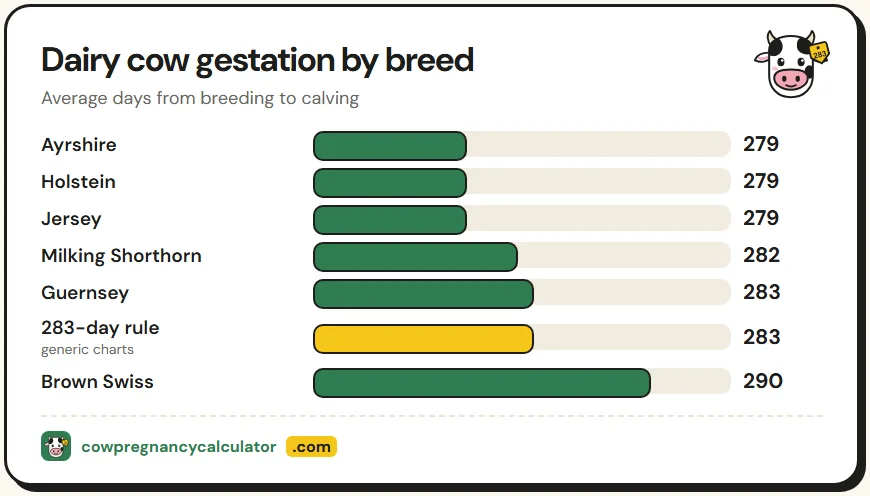
Most dairy cows carry their calves a few days less than beef cows. Holstein, Jersey and Ayrshire average about 279 days, four days under the 283-day rule printed on generic charts. Guernsey sits right on 283, and Brown Swiss is the long one at about 290 days, almost a week past it.
On a dairy those few days matter more than they do on a ranch. The due date sets the dry-off date, the close-up move, the transition ration, the vaccines and the day she can be bred again. Get the gestation wrong by four days and every one of those jobs lands four days off. This dairy cow gestation calculator uses each breed’s own average, and the Dairy setting puts the dry-off date into her timeline.
Dairy breeds: due date, dry-off and close-up
Here is one breeding date, April 1, worked through for each breed. The dry-off date is 60 days before calving, the close-up move 21 days before, and the end of a 50-day voluntary waiting period after calving:
| Dairy breed | Gestation | Dry off | Close-up pen | Due | End of 50-day VWP |
|---|---|---|---|---|---|
| Holstein / Friesian | 279 days | Nov 6 | Dec 15 | Jan 5 | Feb 24 |
| Jersey | 279 days | Nov 6 | Dec 15 | Jan 5 | Feb 24 |
| Ayrshire | 279 days | Nov 6 | Dec 15 | Jan 5 | Feb 24 |
| Milking Shorthorn | 282 days | Nov 9 | Dec 18 | Jan 8 | Feb 27 |
| Guernsey | 283 days | Nov 10 | Dec 19 | Jan 9 | Feb 28 |
| Brown Swiss | 290 days | Nov 17 | Dec 26 | Jan 16 | Mar 7 |
Use the calculator above for your own cow’s dates, with calf sex and twins if you know them. To work a whole group, add each cow to the Herd calving list under the calculator and export it as a CSV for your herd software or a spreadsheet.
Holstein gestation
Holstein (and Friesian) cows average about 279 days, with most calves arriving from about day 270 to day 290. A Holstein bred on April 1 is due around Jan 5. Holstein heifers carry about as long as cows, perhaps a day less. Heifer calves come about a day sooner than bull calves, so cows bred to sexed semen tend to calve a touch early.
Beef-on-dairy calves change things a little. A Holstein carrying an Angus-sired calf usually calves a day or two later than she would with a Holstein calf, and continental sires such as Charolais or Limousin add a few days more. If you breed a share of the herd to beef, set her own gestation under More options, or simply allow a few extra days for the beef-cross cows.
Jersey gestation
Jerseys also average about 279 days. Their calves are small, so calving is usually easy, but Jerseys are more prone than most breeds to milk fever around calving. That makes the close-up period, about 21 days before the due date, especially important: a well-balanced close-up ration and a close eye in the first two days after calving prevent most cases.
A Jersey bred on June 1 is due around Mar 7, dried off around Jan 6 and moved to the close-up pen about three weeks before calving.
Brown Swiss gestation chart
Brown Swiss is the outlier among dairy breeds, at about 290 days. On a 283-day chart a Brown Swiss looks a week overdue when she is right on time, and on a Holstein chart she looks eleven days late. Here is a Brown Swiss gestation chart by breeding month:
| Bred in… | Bred on the 1st → calves | Bred on the 15th → calves | Calving month |
|---|---|---|---|
| January | Oct 18 | Nov 1 | November |
| February | Nov 18 | Dec 2 | December |
| March | Dec 16 | Dec 30 | December |
| April | Jan 16 | Jan 30 | January |
| May | Feb 15 | Mar 1 | March |
| June | Mar 18 | Apr 1 | April |
| July | Apr 17 | May 1 | May |
| August | May 18 | Jun 1 | June |
| September | Jun 18 | Jul 2 | July |
| October | Jul 18 | Aug 1 | August |
| November | Aug 18 | Sep 1 | September |
| December | Sep 17 | Oct 1 | October |
Because of the longer pregnancy, dry off a Brown Swiss cow by her own due date, not by a Holstein calendar. Otherwise her dry period quietly stretches from 60 days to about 70.
The dairy calendar around calving
On a dairy, the due date is the anchor for a whole run of jobs. In order:
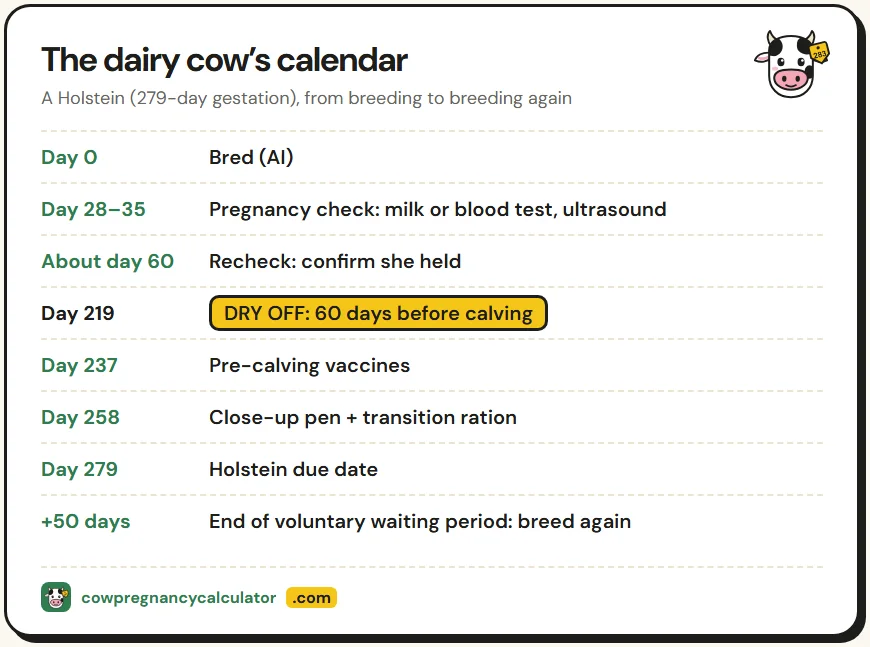
- Pregnancy check (days 28–35). A milk or blood pregnancy test works from about day 28 after breeding, and from at least 60 days after her last calving. Ultrasound works from about day 28–35. Recheck around day 60, because roughly one pregnancy in ten is lost in between.
- Dry off (about 60 days before calving). Stop milking so the udder can rest and rebuild. Some herds use shorter dry periods of 40–45 days; set the timing with your vet and nutritionist.
- Pre-calving vaccines (3–6 weeks before). So the calf gets antibodies in the colostrum. Follow the label and your vet.
- Close-up pen (about 21 days before). The transition ration starts here. This is the period that decides how well she starts her next lactation.
- Calving window (about 10 days either side of the due date). Check close-up cows at least every few hours, and have colostrum ready.
Voluntary waiting period, calving interval and days in milk
After calving, most dairies wait 45–60 days before breeding again. That is the voluntary waiting period (VWP); this calculator uses 50 days. A cow bred at the end of her VWP that settles on the first service would calve again after 50 + 279 = 329 days, under eleven months. Few manage it: every missed heat adds about 21 days, and the usual target is a calving interval of 12 to 13 months.
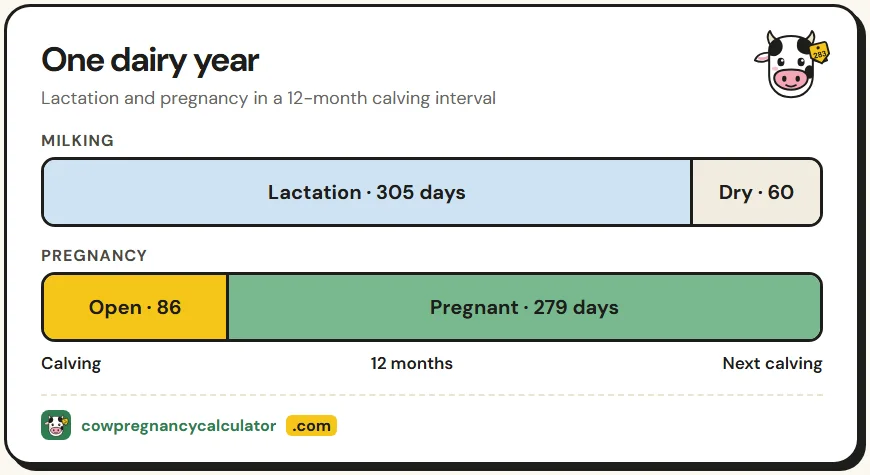
In practice many Holstein herds run a calving interval of 13 to 14 months, because not every cow settles on the first service. Two numbers help you track it:
- Days in milk (DIM) is simply the number of days since she calved. A cow that calved on February 15 is about 100 days in milk on May 26.
- Days open is the number of days from calving until she is pregnant again. To hold a 13-month calving interval with a 279-day gestation, she needs to be pregnant by about day 115 after calving.
The After calving: breed-back dates button under each result shows her own breed-from and breed-by dates, and the cattle breeding calendar plans seasonal-calving dairies the same way.
Using the dairy cow gestation calculator
- Pick the breed. The calculator opens on Holstein with the Dairy setting on, so the dry-off date is already in the timeline.
- Enter the AI date. If you only have a vet’s days-pregnant figure from a herd check, switch to Calving date and type it in the days-pregnant box.
- Under More options, add the calf’s sex if you used sexed semen or had the fetus sexed, tick twins if the scan showed two, or enter the sire’s gestation length figure if your AI catalogue lists one.
- Read her due date, then her full timeline: dry-off, vaccines, close-up and the calving window. Add to calendar puts every date on your phone.
Breeding a heifer for her first calf? Tick First-calf heifer. It shortens the gestation by a day and gives her a longer wait before breeding back.
For beef herds and all 21 breeds, use the cattle gestation calculator; for a printable date-by-date table, the cattle gestation table.
Dairy cow gestation FAQ
How long is a Holstein cow pregnant?
About 279 days on average, or about 9 months and 6 days. Most Holstein calves are born between about day 270 and day 290.
How long is a Jersey cow pregnant?
About 279 days, the same as a Holstein. Jersey heifers may calve a day or so earlier.
What is the Brown Swiss gestation period?
About 290 days, the longest of the common dairy breeds and about eleven days longer than a Holstein.
When should a dairy cow be dried off?
About 60 days before her due date. A Holstein bred on April 1 is due around Jan 5 and should be dried off around Nov 6. Some herds use shorter 40–45 day dry periods on advice from their vet.
Is dairy cow gestation shorter than beef cow gestation?
Usually, by a few days. Holstein, Jersey and Ayrshire average about 279 days, while most beef breeds run 280–289 days. Brown Swiss is the exception at about 290.
How soon after calving can a dairy cow be bred?
Most dairies wait 45–60 days, the voluntary waiting period. Her uterus needs time to recover, and conception rates are low in the first weeks after calving.
Last updated November 9, 2026 · Every date on this page comes from the same data the calculators use.