Quick answer
A cow is pregnant for about 283 days: roughly 9 months and 10 days, or 40 weeks. Most cows calve between day 273 and day 293.
Dairy breeds such as Holstein and Jersey run shorter (about 279 days); Brahman and other Bos indicus cattle run longer (about 292 days).
How long is the cow gestation period?
The cow gestation period is the time from the day she is bred to the day she calves. For cattle the textbook number is 283 days. You will find it on breed association charts, on most printed gestation tables and in nearly every vet school lecture, and it is still a perfectly good number to plan around.
Real herds wobble around it. A normal, healthy cow can calve on any day from about 273 to 293, so treat 283 as the middle of a three-week window and not as an appointment. Large studies of beef herds bred by AI now put the average a little shorter, nearer 279–281 days. Breeders have spent decades choosing bulls that sire small, easy-born calves, and those bulls tend to sire shorter pregnancies as well.
Count day 0 as the day of breeding (the AI date, or the day the bull covered her). Add the gestation length to that date and you have her due date. The tool above does the counting for you and shows what the number looks like in weeks and months.
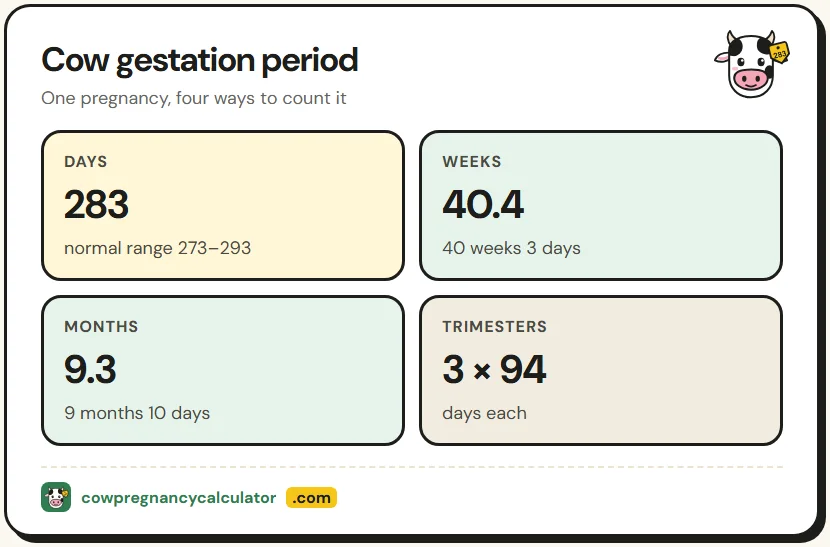
Cow gestation period in days, weeks and months
People ask the question three ways, so here are all three answers for an average cow:
| Unit | Average cow | Normal range |
|---|---|---|
| Days | 283 days | 273–293 days |
| Weeks | 40.4 weeks (40 weeks 3 days) | 39–42 weeks |
| Months | 9.3 months (9 months 10 days on the calendar) | about 9 to 9⅔ months |
| Trimesters | 3 × about 94 days | – |
Months are the slippery unit. A calendar month is 28 to 31 days long, so “9 months and 10 days” is exact only for some breeding dates. A cow bred on January 1 is due on October 11, which is 9 months and 10 days. A cow bred on May 1 is due on Feb 8, which is 9 months and 7 days, because the months in between are longer. When a vet tells you she is “five months along”, they usually mean about 150 days.
If a vet gives you months, multiply by 30.4 to get days. Four and a half months is about 137 days, so she has about 146 days, close to five months, still to go.
Cow gestation period by breed
Breed is the biggest single reason one cow calves earlier than another. The difference from the shortest to the longest common breed is about two weeks:
| Breed | Days | Weeks | Months | Months + days |
|---|---|---|---|---|
| Ayrshire | 279 | 39.9 | 9.2 | 9 months 6 days |
| Holstein / Friesian | 279 | 39.9 | 9.2 | 9 months 6 days |
| Jersey | 279 | 39.9 | 9.2 | 9 months 6 days |
| Angus / Black Angus | 280 | 40.0 | 9.2 | 9 months 7 days |
| Milking Shorthorn | 282 | 40.3 | 9.3 | 9 months 9 days |
| Red Angus | 282 | 40.3 | 9.3 | 9 months 9 days |
| Average / crossbred | 283 | 40.4 | 9.3 | 9 months 10 days |
| Galloway / Belted Galloway | 283 | 40.4 | 9.3 | 9 months 10 days |
| Guernsey | 283 | 40.4 | 9.3 | 9 months 10 days |
| Shorthorn | 283 | 40.4 | 9.3 | 9 months 10 days |
| Hereford | 285 | 40.7 | 9.4 | 9 months 12 days |
| Highland | 285 | 40.7 | 9.4 | 9 months 12 days |
| Santa Gertrudis | 285 | 40.7 | 9.4 | 9 months 12 days |
| Gelbvieh | 286 | 40.9 | 9.4 | 9 months 13 days |
| Maine-Anjou | 286 | 40.9 | 9.4 | 9 months 13 days |
| Other Bos indicus cross | 286 | 40.9 | 9.4 | 9 months 13 days |
| Simmental | 287 | 41.0 | 9.4 | 9 months 14 days |
| Droughtmaster | 288 | 41.1 | 9.5 | 9 months 15 days |
| Charolais | 289 | 41.3 | 9.5 | 9 months 16 days |
| Limousin | 289 | 41.3 | 9.5 | 9 months 16 days |
| Brown Swiss | 290 | 41.4 | 9.5 | 9 months 17 days |
| Brahman | 292 | 41.7 | 9.6 | 9 months 19 days |
Months + days are counted on the calendar from a January 1 breeding; from other dates they can differ by a day or two.
A few patterns stand out. Dairy breeds such as Holstein, Jersey and Ayrshire carry for about 279 days, while Brown Swiss is the long exception at about 290. British beef breeds sit close to the 283-day rule: Angus a little under it at about 280, Hereford a little over at about 285. Continental breeds such as Simmental, Charolais and Limousin run 286–289 days. Bos indicus cattle such as Brahman are the longest, at about 292 days.
There are pages for the breeds people search for most: the Angus gestation calculator, the Hereford gestation chart and the dairy cow gestation calculator for Holstein, Jersey and Brown Swiss. All 21 breeds are side by side on the cattle gestation calculator.
What makes a pregnancy shorter or longer
Once you know her breed, these are the other things that move the date. Each one is small on its own, but they add up:
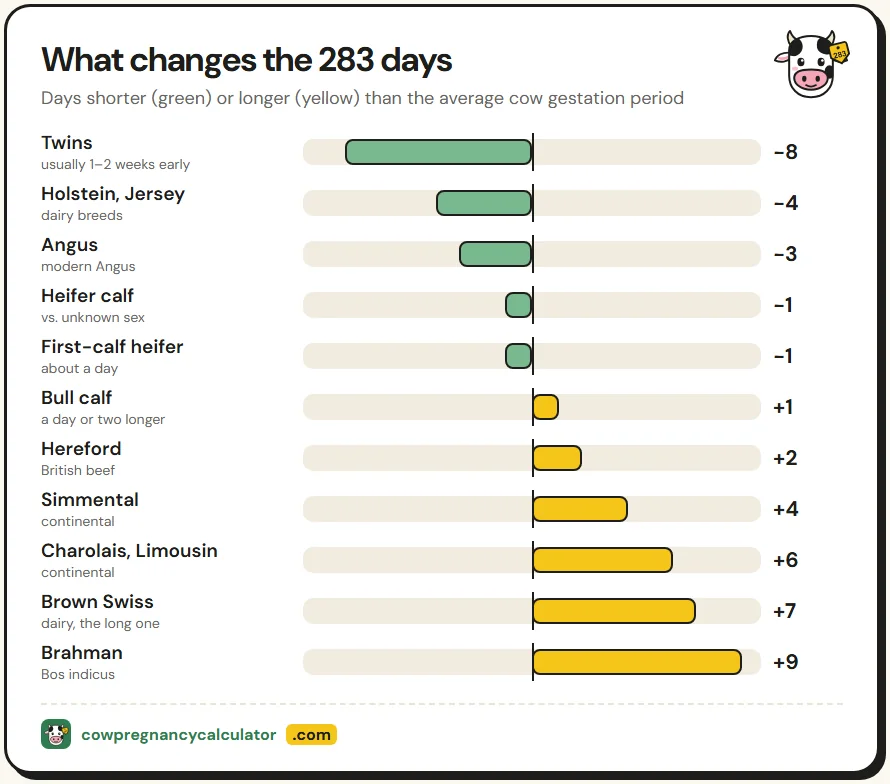
- The bull. Gestation length is strongly inherited, so the sire of the calf matters as much as the cow. Some breed associations publish a gestation length EPD for each bull, and a bull at −5 days will move every calf he sires by about that much.
- Calf sex. Bull calves are carried about a day longer than heifer calves. If you used sexed semen or had a fetal-sexing scan, set the calf’s sex under More options.
- Twins. Twins usually come one to two weeks early, and the cow often needs help. A cow that is unusually big for her stage is worth a scan.
- Her age. First-calf heifers carry about as long as cows, perhaps a day less. Very old cows can run a little longer.
- Her health. Heat stress, a sudden illness or very poor feed can bring a calf early. A calf more than about three weeks early is premature and often weak.
What does not matter much is the time of year or how many calves she has had before. Those effects are a day or less in most studies.
Is a heifer’s gestation period different?
No, not by much. A heifer that is bred at 14–15 months carries her first calf for about the same length of time as a mature cow of her breed, sometimes a day shorter. The difference with heifers is everything around the pregnancy. They are still growing, so they need better feed. They have more trouble calving, so they need watching. And they take longer to come back into heat afterwards, so they need more time before the next breeding season. That is why most herds breed heifers two to four weeks before the cows.
The cow gestation period by trimester
Split 283 days into three and each trimester is about 94 days. They are a handy way to think about feeding and care:
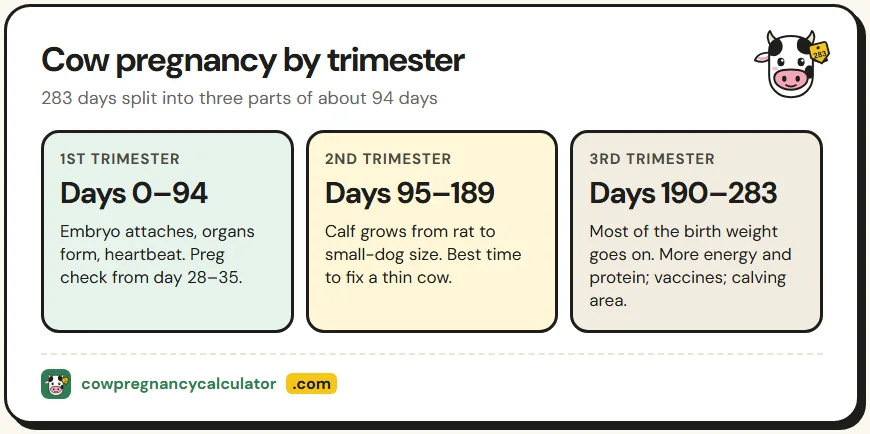
- First trimester (days 0–94). The embryo attaches, the organs form and the heartbeat appears. Pregnancy can be confirmed from about day 28–35. Keep her calm and on a steady diet; this is when most early losses happen.
- Second trimester (days 95–189). The calf grows from rat-size to small-dog size. Her own needs are lowest now, so this is the cheapest time to put weight back on a thin cow.
- Third trimester (days 190–283). Most of the birth weight goes on in these last three months. She needs more energy and protein, and you need to plan vaccines, the calving area and, on a dairy, the dry-off date.
For a month-by-month version with what to do and when, see the cow gestation chart. For fetal size by day, see the bovine gestation chart.
How far along is my cow?
If you know the breeding date, put it into the tool above. It shows how many days, weeks and calendar months pregnant she is today, which trimester she is in and how many days are left. If you only know a range, such as a bull that was in for two months, use the date the bull went in for the earliest possible calving and the date he came out for the latest.
If you only know what the vet found at a pregnancy check, work backwards. Say the vet calls her 100 days pregnant on the day of the check. She was bred about 100 days before that, and she is due about 183 days after it, a little over six months. The cow due date calculator takes a vet’s days-pregnant figure directly and gives the date.
And if you know the due date but not the breeding date, count back. A cow due on April 1 was bred around Jun 22. Today’s count of days pregnant is just today minus that date.
Cow gestation compared with other animals
A cow carries her calf for about as long as a woman carries a baby. Here is where she sits among other farm animals:
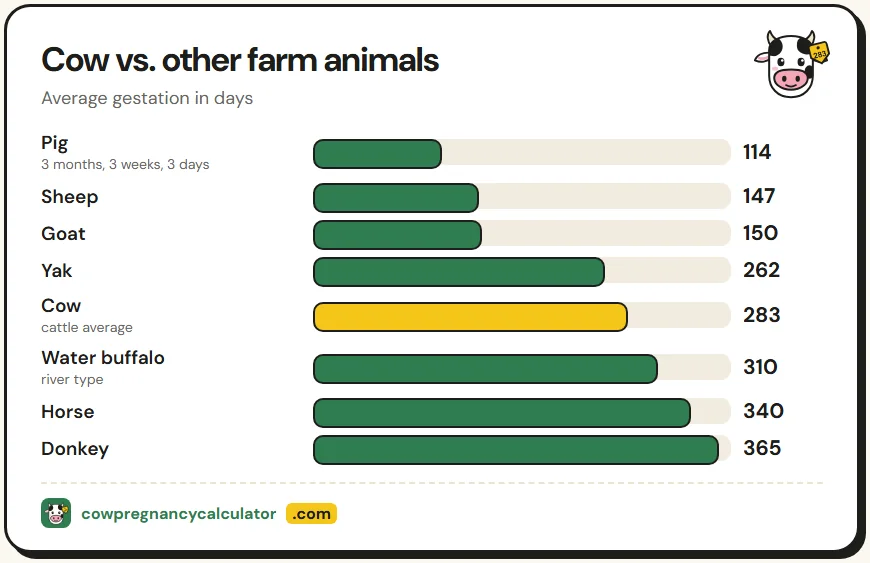
| Animal | Average gestation | In months |
|---|---|---|
| Pig | 114 days | about 3¾ |
| Sheep | 147 days | about 5 |
| Goat | 150 days | about 5 |
| Yak | about 262 days | about 8½ |
| Cow (cattle) | 283 days | about 9¼ |
| Water buffalo (river type) | about 310 days | about 10 |
| Horse | about 340 days | about 11 |
| Donkey | about 365 days | about 12 |
For comparison, a human pregnancy is about 266 days from conception, or the familiar 280 days counted from the last period. Buffalo, bison and yak have their own page under bovine gestation.
How soon can a cow be pregnant again?
A cow usually comes back into heat 40 to 60 days after calving, later if she is thin or a first-calf heifer. Most herds start breeding again around day 50. To have a calf every 12 months, a 365-day calving interval, she has to be pregnant again by about day 82 after calving, because 365 − 283 = 82. Miss that and she calves later every year until she drops out of the calving season. The cattle breeding calendar works out those dates for the whole herd.
Cow gestation period FAQ
How long is a cow pregnant in months?
About 9 months and 10 days, or 9.3 months on average. Depending on the breed and the breeding date, that is anything from about 9 months and 6 days (Holstein, Jersey) to about 9 months and 19 days (Brahman).
How many weeks is a cow pregnant?
About 40 weeks: 283 days is 40 weeks and 3 days. The normal range is roughly 39 to 42 weeks.
Can a cow be pregnant for 10 months?
Rarely. Ten calendar months is about 304 days, well past the normal window of 273–293 days. Some Brahman and Brown Swiss cows come close to 300 days, but a cow that is more than about 10 days past her due date should be checked by a vet.
What is the gestation period for cattle?
The gestation period for cattle averages 283 days, with breed averages from about 279 days (Holstein, Jersey) to about 292 days (Brahman). Bulls, calf sex and twins shift it by a few days.
How long is a heifer pregnant?
About the same as a cow of the same breed: roughly 283 days, sometimes a day shorter. Heifers bred to calving-ease bulls often calve a few days before the breed average.
Do cows carry bull calves longer?
Yes, by about one to two days on average. Bull calves are also a little heavier at birth, which is one reason they cause more calving difficulty.
How many calves can a cow have in a year?
One. With a 283-day pregnancy and at least 50–80 days to get back in calf, one calf a year is the best a cow can do. Twins happen in about 1–2% of beef calvings and somewhat more often in dairy cows.
What is the shortest normal gestation for a cow?
Around 270–273 days in most breeds. Calves born much earlier than that are premature: they may be small and weak and need help to stand and suckle.
Last updated November 9, 2026 · Every date on this page comes from the same data the calculators use.