Quick answer
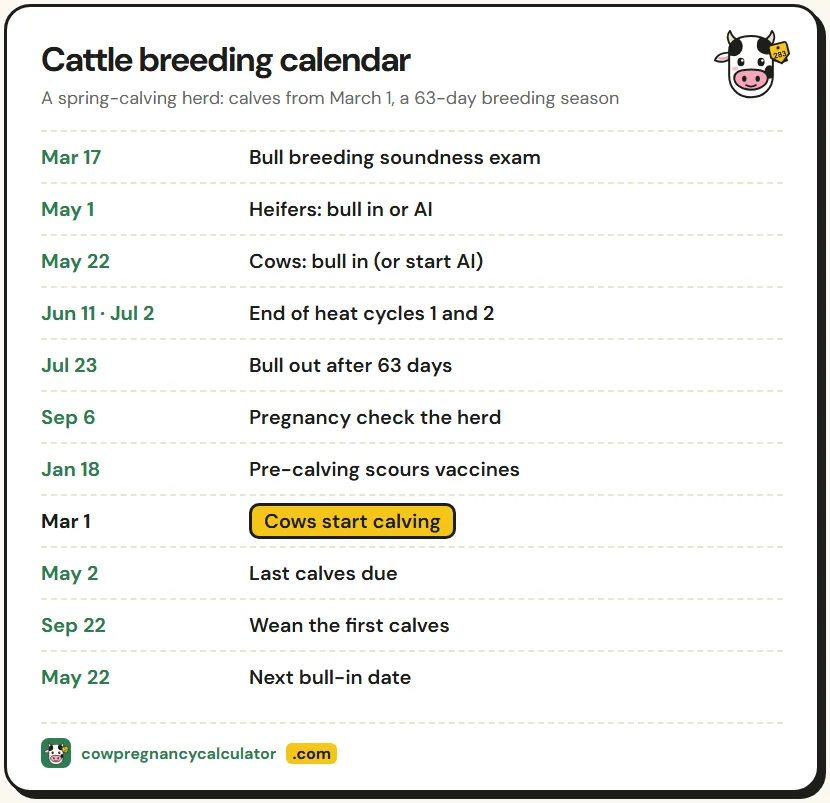
Bull-in date = the day you want calving to start − 283 days. For calves from March 1, the bull goes in around May 22; for calves from September 1, around Nov 22.
Pull the bull after 63 days (three heat cycles) for a calving season of about two months, and breed the heifers three weeks before the cows.
How to use the cattle breeding calendar
Most breeding plans go the wrong way round. People turn the bull out when it suits them in spring and then find out nine months later when calving lands. A cattle breeding calendar works backwards from the calving date you actually want:
- Enter the day you want the cows to start calving. Think about weather, grass, labour and when you sell calves. The calendar opens with a date about ten months away, so the first jobs are only weeks off.
- Pick the length of the breeding season. 63 days, which is three heat cycles, gives a calving season of about two months. 42 days is tighter; 84 days catches more late cows but spreads the calf crop.
- Pick the breed. Angus calves come a few days early, Brahman-type cattle about a week late, so the bull-in date moves with them.
The answer is the day the bull goes in. Under it you get the heifer date, the pregnancy check and the calving season, and the Full breeding calendar button lists every job of the year in date order. Add all dates to calendar sends them to your phone.
Tick Start with timed AI under More options if you synchronize the cows. The calendar then adds the CIDR-in, CIDR-out and AI dates, and puts the clean-up bulls in ten days after AI.
Cattle breeding calendar by calving month
If you just want the dates on paper, here is the whole year. Find the month you want calving to start; the row gives you the matching breeding season for an average 283-day gestation and a 63-day season:
| First calves wanted | Heifers in | Bull in / start AI | Bull out (63 days) | Preg check from | Wean (205 days) |
|---|---|---|---|---|---|
| Jan 1 | Mar 3 | Mar 24 | May 25 | Jul 9 | Jul 25 |
| Feb 1 | Apr 3 | Apr 24 | Jun 25 | Aug 9 | Aug 25 |
| Mar 1 | May 1 | May 22 | Jul 23 | Sep 6 | Sep 22 |
| Apr 1 | Jun 1 | Jun 22 | Aug 23 | Oct 7 | Oct 23 |
| May 1 | Jul 1 | Jul 22 | Sep 22 | Nov 6 | Nov 22 |
| Jun 1 | Aug 1 | Aug 22 | Oct 23 | Dec 7 | Dec 23 |
| Jul 1 | Aug 31 | Sep 21 | Nov 22 | Jan 6 | Jan 22 |
| Aug 1 | Oct 1 | Oct 22 | Dec 23 | Feb 6 | Feb 22 |
| Sep 1 | Nov 1 | Nov 22 | Jan 23 | Mar 9 | Mar 24 |
| Oct 1 | Dec 1 | Dec 22 | Feb 22 | Apr 8 | Apr 23 |
| Nov 1 | Jan 1 | Jan 22 | Mar 25 | May 9 | May 24 |
| Dec 1 | Jan 31 | Feb 21 | Apr 24 | Jun 8 | Jun 23 |
Read it like this: for cows to start calving on February 1, the heifers go to the bull around Apr 3, the cows around Apr 24, and the bull comes out nine weeks later. For a breed-specific version, pick the breed in the planner above. Angus, for example, moves every breeding date about three days later because the calves come sooner.
Choosing when the calves come
The calving date drives everything else, so pick it on purpose. There is no single right answer; it depends on where you farm and how you sell.
| Calving in… | Breed in… | Good for | Watch out for |
|---|---|---|---|
| January–February | April–May | Heavier calves at weaning; calves sold before the fall rush | Cold, wet calving weather; most hay fed |
| March–April | June–July | Calving lines up with spring grass; the most common choice | Breeding in summer heat; mud at calving |
| May–June | August–September | Calving on pasture with little labour; cows milk on grass | Lighter calves at a fall weaning |
| August–October (fall) | November–January | Mild calving weather; calves sold when prices are often higher | Breeding in winter; cows nursing on stored feed |
Once you have a season, the calving calculator shows how a given bull-in and bull-out date spreads the calves into 21-day calving periods.
The 21-day heat cycle: the heart of the breeding chart
Every cattle breeding chart is built on one number: a cow that is not pregnant comes back into heat about every 21 days (anywhere from 18 to 24). That is why breeding seasons come in multiples of 21 days, and why the calendar marks the end of each heat cycle.
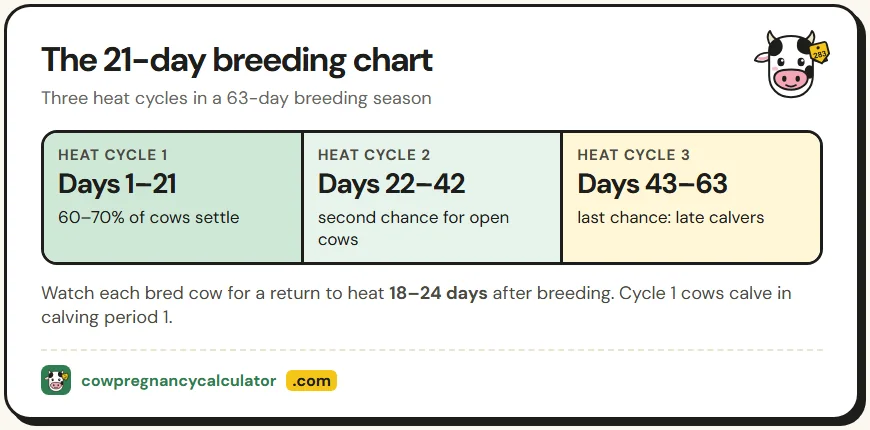
- Cycle 1 (days 1–21). Every cow that is cycling should come into heat once. In a well-fed herd, about 60–70% settle now.
- Cycle 2 (days 22–42). Cows that did not settle come back into heat and get a second chance, along with late-calving cows that have only just started cycling.
- Cycle 3 (days 43–63). The last chance in a 63-day season. Cows that settle here calve late next year, and will be even later the year after unless they catch up.
Standing heat lasts only about 8 to 18 hours, and much of it happens at night. If you breed by AI on observed heats, the old AM/PM rule still works: a cow first seen standing in the morning is bred that evening, and one first seen in the evening is bred the next morning.
For a single cow, watch for a return to heat 18–24 days after she is bred. If she stands again, she is open and can be bred again. If she does not, that is the first sign she has settled.
Breeding season length and the bull
A shorter breeding season makes a shorter calving season. That means a more even calf crop, easier feeding and a quick way to spot the cows that do not breed on time. Many ranchers aim for a 60–65 day season for cows and a 45-day season for heifers.
- Test the bull first. A breeding soundness exam 30–60 days before turnout checks semen, scrotal size, feet, legs and eyes. A bull that fails is far cheaper to find in spring than a pen of open cows in fall.
- Do not overload him. As a rough guide on good pasture: a yearling bull for 15–20 cows, a two-year-old for 20–25, a mature bull for 25–35. Rough, brushy or very large paddocks need more bulls.
- Vaccinate ahead. Reproductive vaccines go in at least 30 days before breeding, as your vet advises. The calendar puts them there for you.
- Watch him work. In the first cycle, check that he is mounting and settling cows. Lameness or a lost interest in the first three weeks can cost a whole cycle.
In Australia and New Zealand the breeding season is usually called the joining period, and the bull-in date the joining date. The arithmetic is the same.
A timed AI breeding calendar
Synchronization lets you breed a group of cows by AI on one day without heat detection. One of the most widely used programs for beef cows is the 7-day CO-Synch + CIDR. On a calendar it looks like this:
| Day | Job | Notes |
|---|---|---|
| Day 0 | GnRH injection, CIDR insert in | Ten days before the AI date |
| Day 7 | Prostaglandin injection, CIDR out | Pulled in the evening, the AI falls on the morning of day 10 |
| Day 10 | Timed AI + GnRH | About 60–66 hours after CIDR removal for cows; about 54 hours for heifers |
| Day 20 | Clean-up bulls in | So AI calves and bull calves can be told apart |
| Day 40 (AI + 30) | Ultrasound for AI pregnancies | Shows which cows settled to the AI sire |
Protocols change as research moves on, and doses depend on the products you use, so follow your vet and the current protocol sheet. The point of the calendar is to make sure the day 10 AI lands exactly 283 days (or your breed’s gestation) before the day you want calving to start.
Breeding back: the 365-day calving interval
A cow pays her way by raising a calf every year. With a 283-day pregnancy, that leaves her only 82 days after calving to get pregnant again: 365 − 283 = 82. That window, often rounded to “80 to 85 days”, is the most important number on any breeding calendar.
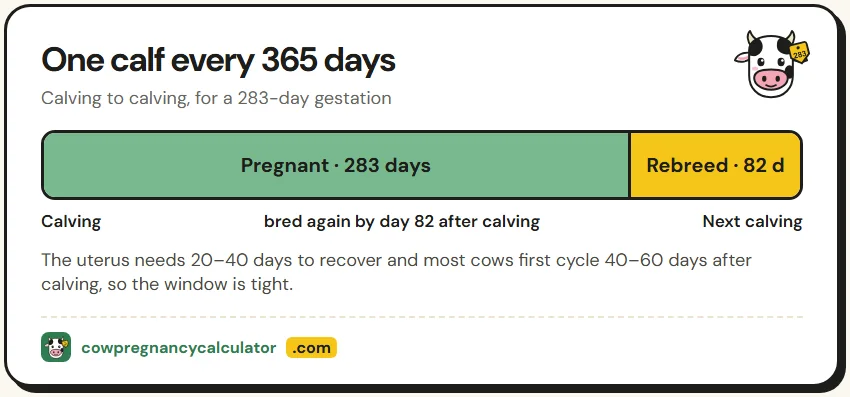
Two things eat into those 82 days. The uterus needs about 20–40 days to recover after calving, and most beef cows do not cycle again for 40–60 days, longer if they calved thin. First-calf heifers are the slowest of all, which is why breeding them three weeks ahead of the cows matters: it gives them those three weeks back the following year.
Body condition at calving is the lever you control. A cow that calves at a body condition score of 5–6 (on the 1–9 scale) usually cycles in time; a cow at 3–4 often does not. The calving calculator’s breed-back section has the numbers, and every cow’s breed-by date appears under her calving date in the cow pregnancy calculator.
Pregnancy checking and the open cows
About 45–60 days after the bull comes out, have the whole herd pregnancy checked. By then even the cows bred on the last day of the season are far enough along for palpation or ultrasound. The calendar puts this date in for you.
The check tells you three things. Which cows are open, so you can sell them before you feed them all winter. Which cows are early, middle or late, so you can sort them for feeding and calving. And how well the breeding season went: if fewer than about 90% of the cows are pregnant, look at the bull, the cows’ condition and herd health before next year.
Once you know who is pregnant, the cattle gestation table or the cow due date calculator turns each breeding date into a calving date.
Cattle breeding calendar FAQ
When should I put the bull in with my cows?
283 days before you want calving to start. For calves from March 1, put the bull in around May 22. Put him in with the heifers about three weeks earlier.
If I turn the bull out today, when will the cows calve?
The first calves will come about 283 days from today, roughly 9 months and 10 days. The last calves come about 283 days after the bull is taken out. The calving calculator gives the exact dates for any bull-in and bull-out date.
How long should a cattle breeding season be?
About 60–65 days for cows, which is three heat cycles, and about 45 days for heifers. Longer seasons catch a few more cows but give a spread-out, uneven calf crop.
How soon after calving should a cow be bred back?
From about 50 days after calving, and she must be pregnant again by about day 82 to calve at the same time next year. First-calf heifers usually need longer, often 60–80 days, before they cycle.
Within how many days of calving must a cow be rebred for a 365-day calving interval?
About 80 days, or 82 to be exact for a 283-day gestation (365 − 283). Breeds with a longer gestation, such as Brahman, have even less time.
What is a cattle breeding chart?
A chart or table that links a breeding date to a calving date, or a calving date back to the breeding date. The cattle gestation table is the breeding-date-to-calving-date version; the table on this page goes the other way, from the calving date you want to the breeding season.
When should cows be pregnancy checked?
About 45–60 days after the bull comes out, so every cow is far enough along to be checked. AI-bred cows can be scanned by ultrasound from about 30 days after AI.
Last updated November 9, 2026 · Every date on this page comes from the same data the calculators use.