Quick answer
A cow’s due date is about 283 days after she was bred (9 months and 10 days). Most cows calve within 5 days of it and nearly all within 10.
Bred on August 1? She is due around May 11. Vet says she is 150 days pregnant today? She has about 133 days to go.
How to use the cow due date calculator
Start with whatever you have. An AI date or the day you saw her bred gives the most accurate answer. If the bull ran with the herd, use the bull-in and bull-out dates and you’ll get the earliest and latest she could be due. And if all you have is a vet’s “about 150 days” from a preg check, choose Calving date, type the days pregnant, and the cow due date calculator counts forward from there.
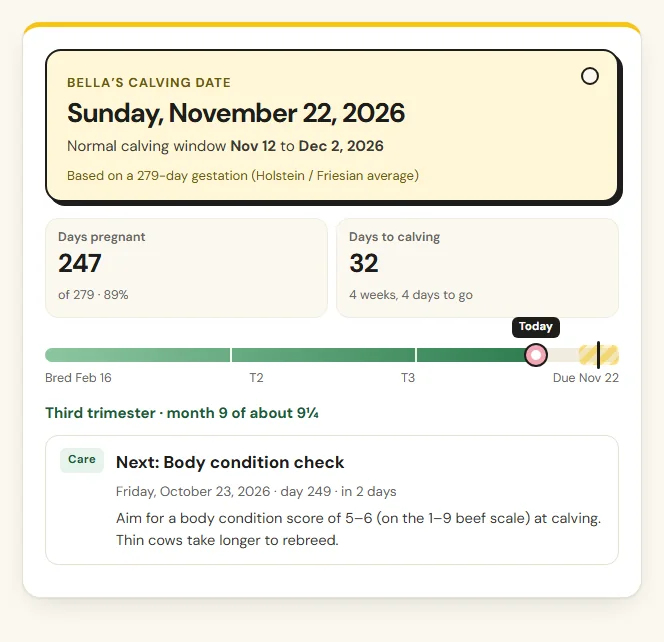
Add her breed for a closer date. The result shows the due date, a countdown in days and weeks, and the next job on her timeline.
How accurate is a cow’s due date?
Pretty accurate, as long as you know when she was bred. A big Kansas State University study of Angus AI pregnancies found gestation length varied by a standard deviation of only about 4.7 days. What that means on the ground:
The due date is less certain when you don’t know the breeding date. A vet’s fetal-age estimate at a preg check is usually good to within a week or two, and a bull-exposure season can spread calving over two or three months.
Cow due dates by breed
Breed shifts the due date by up to two weeks. For a cow bred on the same day, March 1:
| Breed | Average gestation | Bred March 1 → due |
|---|---|---|
| Holstein, Jersey, Ayrshire | 279 days | Dec 5 |
| Angus | 280 days | Dec 6 |
| Average / crossbred | 283 days | Dec 9 |
| Hereford | 285 days | Dec 11 |
| Simmental | 287 days | Dec 13 |
| Charolais, Limousin | 289 days | Dec 15 |
| Brahman | 292 days | Dec 18 |
All 21 breeds are in the calculator’s breed list and on the cattle gestation by breed table.
Cow due date chart by breeding month
A quick reference at 283 days: find the month she was bred.
| Bred in… | Bred on the 1st → calves | Bred on the 15th → calves | Calving month |
|---|---|---|---|
| January | Oct 11 | Oct 25 | October |
| February | Nov 11 | Nov 25 | November |
| March | Dec 9 | Dec 23 | December |
| April | Jan 9 | Jan 23 | January |
| May | Feb 8 | Feb 22 | February |
| June | Mar 11 | Mar 25 | March |
| July | Apr 10 | Apr 24 | April |
| August | May 11 | May 25 | May |
| September | Jun 11 | Jun 25 | June |
| October | Jul 11 | Jul 25 | July |
| November | Aug 11 | Aug 25 | August |
| December | Sep 10 | Sep 24 | September |
For every single day of the year, print the full cattle gestation table.
Is she close? Signs by time before calving
| Time before calving | What you may see |
|---|---|
| 1–2 months | Heifers start “springing”: the udder slowly fills. Belly drops low on the right. |
| 2–3 weeks | Udder fills in older cows; the vulva starts to swell and soften. |
| A few days | Teats look full and shiny; the tail-head ligaments start to relax. |
| 12–24 hours | Tail head looks raised with deep hollows either side; she may go off alone and stop eating. |
| Hours | Restless, tail held out, clear mucus string, lying down and getting up: stage 1 labor. |
When the water bag or feet appear she is in stage 2. See the stages of calving and when to help.
Write each cow’s due date on a whiteboard in the barn, or add them all to your phone with Add to calendar. You’ll know which cows to check first every morning.
What if she goes past her due date?
A few days over is nothing to worry about. Bull calves, certain sires and some breeds simply run long. Most people start calling a cow overdue when she’s more than about 10 days past her date.
Before you worry, double-check the date. Was she bred again on a later heat? Did a clean-up bull get to her? Either one pushes her real due date back about three weeks, and it happens more often than you’d think.
What does need a vet straight away is a smelly or bloody discharge, a cow that’s off her feed and dull, or one straining hard without getting anywhere. And don’t try to induce her yourself. Inducing calving is a veterinary call, timed carefully against the due date.
What if she calves early?
Twins usually come 1–2 weeks early, and young heifers can calve a few days early. A calf born more than about 3 weeks early may be premature: weak, slow to stand and suck, with a fine hair coat. Get colostrum into it quickly, keep it warm and call your vet.
Due dates on a dairy
On a dairy the due date drives the whole schedule: dry off about 60 days before, move to a close-up group about 21 days before, and plan pre-calving vaccines in between. Choose Dairy under More options and the dry-off date appears in her timeline.
Cow due date FAQ
How do I figure out when my cow is due?
Add 283 days to the day she was bred (or her breed’s average). A cow bred on August 1 is due around May 11. The cow due date calculator also gives the normal window and a countdown.
How many days can a cow go past her due date?
Up to about 10 days is common and usually normal. Past that, or if she shows signs of trouble, call your vet.
Do heifers calve before their due date?
Often a day or two early, but not always. Use the due date as the middle of a 20-day window and start checking heifers closely about 10 days before it.
How can I tell how far along my cow is?
From the breeding date, the calculator tells you exactly. Without one, a vet can estimate fetal age by palpation or ultrasound; enter those days pregnant in the calculator to get a due date.
How do I calculate a due date if the bull was with the cows?
Use the bull-in and bull-out dates. The earliest calves are due about 283 days after the bull went in and the last about 283 days after he came out.
What time of day do cows usually calve?
Cows can calve at any hour. Some ranchers feed in the evening because research has found it shifts more calvings into daylight hours.
Last updated October 21, 2026 · Every date on this page comes from the same data the calculators use.